
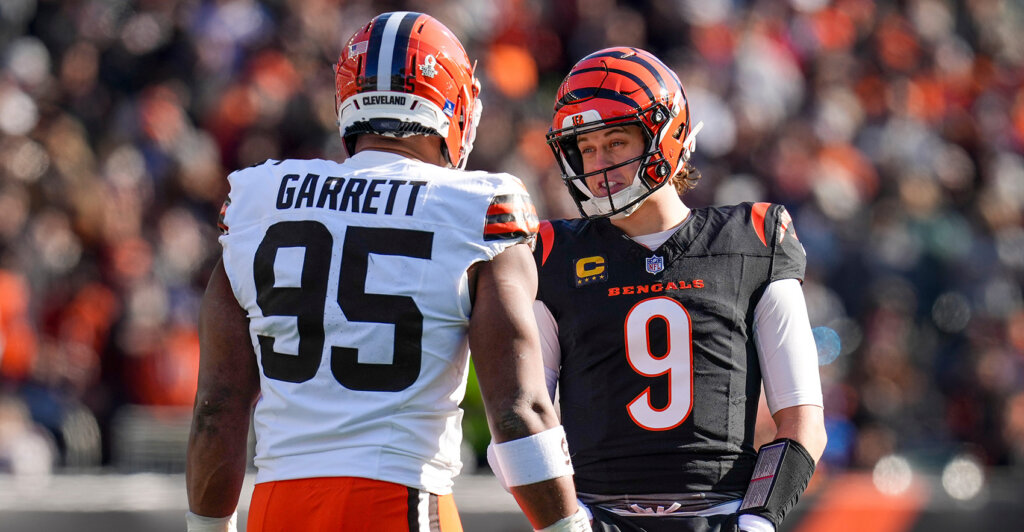
If you are a commissioner and want to include individual defensive players (IDPs) in your fantasy football league, you are in the right place. This guide shows you how to set up a fantasy football league with both offensive and defensive players, even if you are new to IDP leagues.
The steps to setting up a successful IDP league will be based on the S.T.A.R method mentioned in Fantasy 101: How to Not Look Like a Fool at Your Draft, so managers will have the exact information they need to succeed.
Determine the S.T.A.R. Settings:
Scoring format: Make sure each position is not too overpowered or underpowered.
Teams in the League: Find managers who want to play in an IDP league.
Active Roster Setup: Determine how many IDP starters will be best for the league, and consider that two are better than one.
Rounds in the Draft: The number of draft rounds is determined by team roster size.
By determining these settings, your league will be on the path towards a great IDP experience.
IDP Abbreviations
IDP
Individual Defensive Player
DL
Defensive Lineman (Edge, DL, DT)
Edge
Edge Rusher
DE
Defensive End
DT
Defensive Tackle
LB
Linebacker
DB
Defensive Back (S, CB)
S
Safety
CB
Cornerback
Scoring Format
IDP scoring varies greatly from league to league. The most common scoring format used for IDP leagues is “Big 3 Scoring,” but the majority of leagues have customized settings. Make sure each position is not too overpowered or underpowered. It is regularly accepted that QBs score the most fantasy points, so it is better to compare the scoring of IDP positions to the other offensive positions. If one position regularly outscores the others by a wide margin, managers may not be as diligent in managing the other positions. Leagues with an equal number of offensive and defensive positions succeed when scoring is relatively balanced between offensive and defensive players.
After inputting scoring values, the balance of league scoring can be evaluated by comparing the average season-long points for the top 24 players of each position, including the IDP positions. In one of my leagues last year, managers started three LBs and three WRs, and the top 24 LBs averaged within a point of the top 24 WRs in season-long totals. Some leagues prefer LBs to score similarly with RBs. Comparing positional season-long scores may not be a perfect science, but it can help you determine what is best for your league and fine-tune scoring settings.
In many leagues, there are rewards for big plays and week-winning performances, such as a 100-yard rushing game. It can be like that in IDP leagues as well, with more points for multiple sacks, forced fumbles, or interceptions. If your league has offensive bonuses, consider adding defensive bonuses as well.
Something to keep in mind is scoring for return yards and tackles. Many NFL teams have WRs return punts and kickoffs, but occasionally a defensive player fills that role. Determine if your league will credit those players with points for return yardage and/or special teams TDs. Another neat wrinkle is that offensive players can earn points from making tackles on interceptions or fumble recoveries. Consider this for the league as well as a way to reward effort.
Teams In The League
Determine how many teams will be in the league. This will sound simple, but it is very important: find managers who want to play in an IDP league. All fantasy leagues work best with committed, engaging managers, and the same is true for leagues with IDPs. It is understandable if managers are hesitant to try an IDP format, which is exactly why this introductory guide exists. It is better to have a league with fewer managers who are committed than to have a larger league with some managers who will check out mid-season. One or two inactive owners can bring down the whole league, so league size should be determined by how many committed managers will join. “We need volunteers, not hostages.” – Coach Mike Tomlin
Active Roster Construction
Determine the starting rosters, including how many IDPs will start. Be sure to ditch team defense (DST) to make room for IDPs. Some leagues are comfortable with having one or two IDPs in the starting lineup, and while it is great to have a little taste of the defensive action, allow me to encourage you to increase IDP roster slots to more than one or two. Having multiple starters at an IDP position provides more chances to celebrate IDP success. Two are better than one. In leagues with 12 or fewer managers, three IDP starting roster slots may be even better than two.
Imagine if managers could only start one RB. Learning about the RB23 would hardly matter, and managers would not even know the name of RB sleepers unless they suddenly became the starter. The top 12 RBs on any given week are rarely the exact top 12 RBs from the league draft, but they are typically from the top 24 RBs drafted. It is the same with WRs and TEs. Even the best offensive players do not score TDs every week, and it is the same with IDPs having big scoring plays like sacks, forced fumbles, or INTs. There are 32 teams in the NFL, and scoring opportunities are everywhere, so there is enough IDP depth to field multiple roster slots.
Generally, following the top 24-36 IDPs at a position can produce the same amount of IDP success while requiring less homework than selecting the exact one player with a decent chance of having a big week. Give managers double or triple the chance to capture the big weekly performances by having multiple roster slots. Consider expanding league rosters to an equal number of offensive and defensive starters. The NFL has eleven offensive starters and eleven defensive starters, so maybe your league could too.
Bonus side effect of having more IDP starters: kickers cannot hurt you anymore! They can help teams, but their impact on the weekly outcome is mitigated. Managers can still celebrate great kickers without feeling personally attacked when the opposing kicker has a big week. If a kicker has a big week while there are 9 other offensive starters and 10 defensive starters, the blame for the loss almost certainly falls squarely on the shoulders of the losing manager rather than a lucky kicker.
Redraft/Keeper Roster Suggestions
For redraft and keeper leagues, I recommend introducing IDP with 2 DLs, 2 LBs, and 3 IDP Flex (DLs, LBs, and DBs). It may be surprising not to have dedicated roster slots for DBs, but trust me: DB fantasy strategy can be counter-intuitive, so if the league is new to IDP strategies, it is okay to offer the DB option without demanding inclusion. Having IDPs creates more waiver activity, and more players are available to balance trades.
Dynasty Roster Suggestions
For dynasty leagues with IDP, I recommend jumping right in with something like: 3 DE, 3 LB, 3 DB, 2 IDP flex (DLs, LBs, and DBs). Some commissioners like 2 S and 2 CB instead of 3 DB, but transitioning the league from 3 DB to 2 S and 2 CB is easier than transitioning the other direction.
Rounds in the Draft
The number of draft rounds is determined by team roster size. Be sure to have one round for each roster spot (starters and bench combined). If a redraft league will have 16 starters (9 offensive players, 7 IDPs) and 10 bench players, make sure the draft has 26 rounds. Consider hosting a slow draft if needed.
Much like in an offensive-only league, bench size will determine waiver and trade activity. If the league is mostly managers new to IDP, they may want to fill the entire bench with offensive players. This may or may not be healthy for league activity, so determine what would be healthier for the league and set clear expectations as necessary.
Bonus recommendation: IDP projections can vary wildly between platforms or even leagues due to scoring settings. It may be best to find good resources suited to the league settings and prepare for drafts with your own IDP rankings and tiers rather than relying on the default platform rankings. Tier-based drafting remains highly recommended.
Dynasty Drafts
If the dynasty league is already established and chooses to incorporate IDPs, many platforms have an option to hold a supplemental draft. It could be made clear that only IDPs are eligible to be drafted. If managers already have team defense before adding IDPs, consider rewarding their investment by awarding supplemental draft picks, additional chances for any draft lottery selections, or whatever you determine is appropriate compensation.
If a supplemental draft is determined to be needed, consider allowing the trading of picks and offensive players, but know your league and establish clear expectations accordingly. Some leagues incorporating IDPs choose to have the IDP supplemental draft before the rookie draft (which would include offensive and defensive rookies). Some leagues choose to have the rookie draft (offensive players only) first, with the supplemental draft to include IDP rookies and veterans. Whether the supplemental IDP draft is before or after the rookie draft, it is recommended waivers remain locked until BOTH drafts are completed.
Following any IDP draft, future rookie drafts will incorporate both offensive and defensive players, so consider adding an additional round or two. Doing so will ensure talent is captured in the draft, and the league will have more tradable assets.
You Can Do It!
You can set up a league for managers to have a great IDP experience! Even if you have no experience with IDPs yourself, by determining the S.T.A.R. settings and creating clear expectations, the league will experience a whole new level of fantasy football engagement and hopefully a whole new level of camaraderie too.
from Fantasy Footballers Podcast https://ift.tt/xZWTpVj


No comments: